PROJECT:
Testing the Stability of Individual Altruism Over Time
Prosocial Behavior ❖ Longitudinal Measurement ❖ Bayesian Hierarchical Models ❖ Equivalence Testing
People differ in altruism, but is altruism a stable behavioral trait?
I examined its stability by developing an optimized computerized task and measuring behavior across time. The results show that individual altruism remains consistent across longitudinal sessions, supporting its reliability as a personal trait.
MY ROLE: Within a large team of behavioral scientists, neuroscientists, and psychiatrists, I led:
research strategy
design, optimization, and implementation of a new behavioral task
automated data preprocessing
modeling (behavioral economics model, Bayesian hierarchical modeling, equivalence testing)
visualization and interpretation
stakeholder communication
BEHAVIORAL INSIGHTS + industry implications
Research question
Is altruism a stable behavioral trait? If prosocial behavior can be reliably characterized at the individual level, it forms a viable basis for reliable personalization, segmentation, and intervention design. Furthermore, the methodology developed here is applicable to other domains where individuation matters, such as financial risk-taking, consumer behavior, and health behavior.
Study design
This was a longitudinal study; participants completed a computerized task in two behavioral sessions, at least a week apart (see the note below).
Participants made a series of choices of how to split money with an anonymous partner. For each decision, participants were presented with two payoff options to choose from. I parametrically varied the options over choices to quantify how much each participant was willing to give up to benefit someone else. No choice was repeated between sessions.
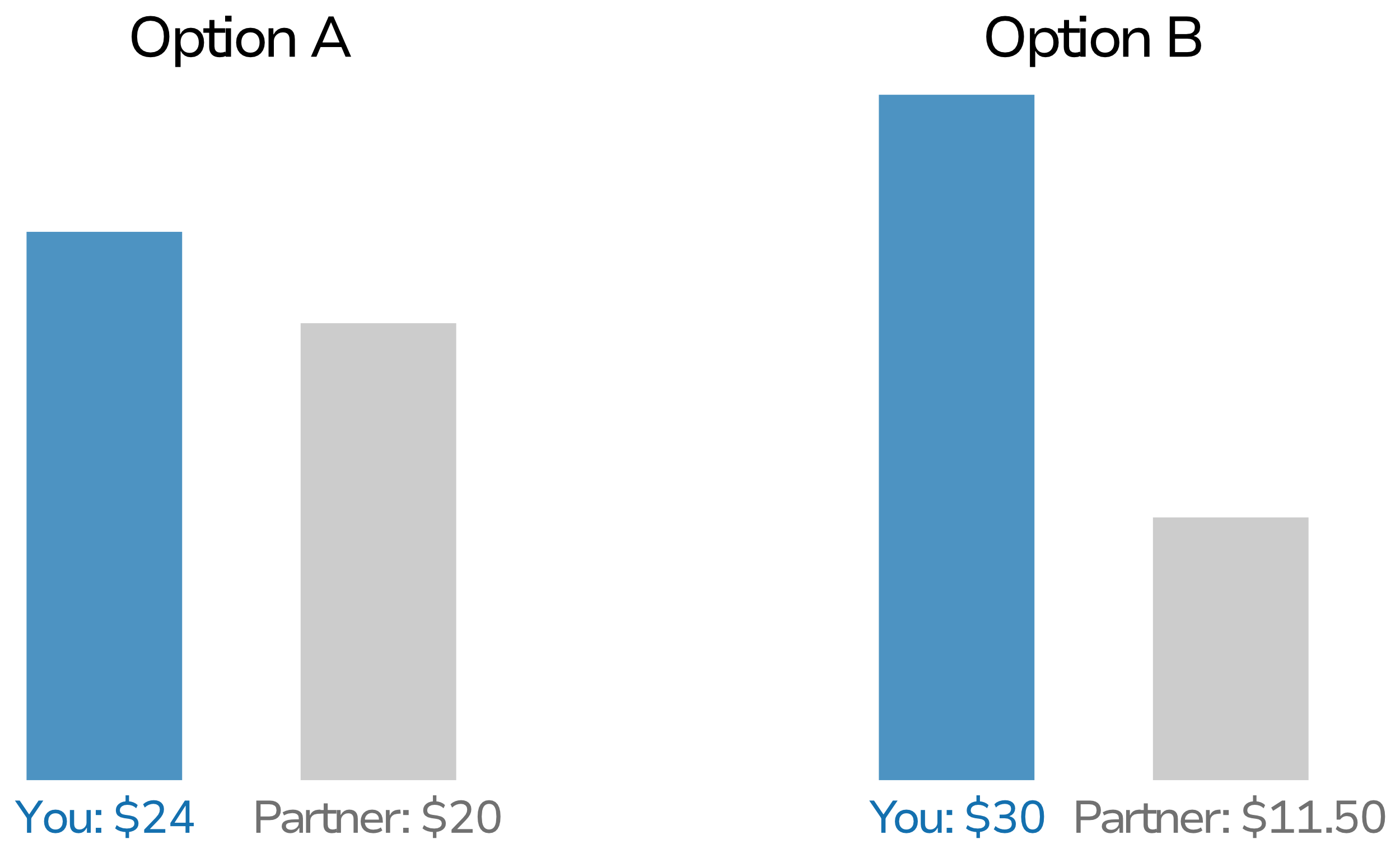
Participants chose between Options A and B, each offering different payoffs for themselves and an anonymous partner. The payoff amounts varied across choices.
Finding
While altruism differed across individuals, it was highly consistent within individuals across sessions, demonstrating trait-like stability. For behavioral segmentation or personalization, this demonstrates that individual-level behavioral measurement is achievable with careful experiment and model design, providing a valid alternative to surveys, based on observed behavior rather than self-reports.
MODELING + data science relevance
Challenge
A standard behavioral economics model captures individual altruism with one free parameter. To assess whether this parameter was stable across sessions, I needed reliable individual estimates and a principled way to test stability. Standard hypothesis testing cannot confirm equivalence (absence of change), and thus a different approach was required.
Approach
I addressed those challenges by jointly optimizing experiment design and modeling.
I conducted model simulations to optimize parameter recovery within the limited session time (while avoiding choice repetitions across sessions).
I used Bayesian hierarchical modeling for robust individual parameter estimates.
I conducted equivalence testing, comparing observed session-by-session change against a pre-defined Region of Practical Equivalence (ROPE). To define ROPE, I used the smallest detectable change from model simulation.
This holistic experiment-model synergy is beneficial whenever individual behavior must be reliably quantified.
Results
Individual altruism estimates were strongly correlated across sessions.
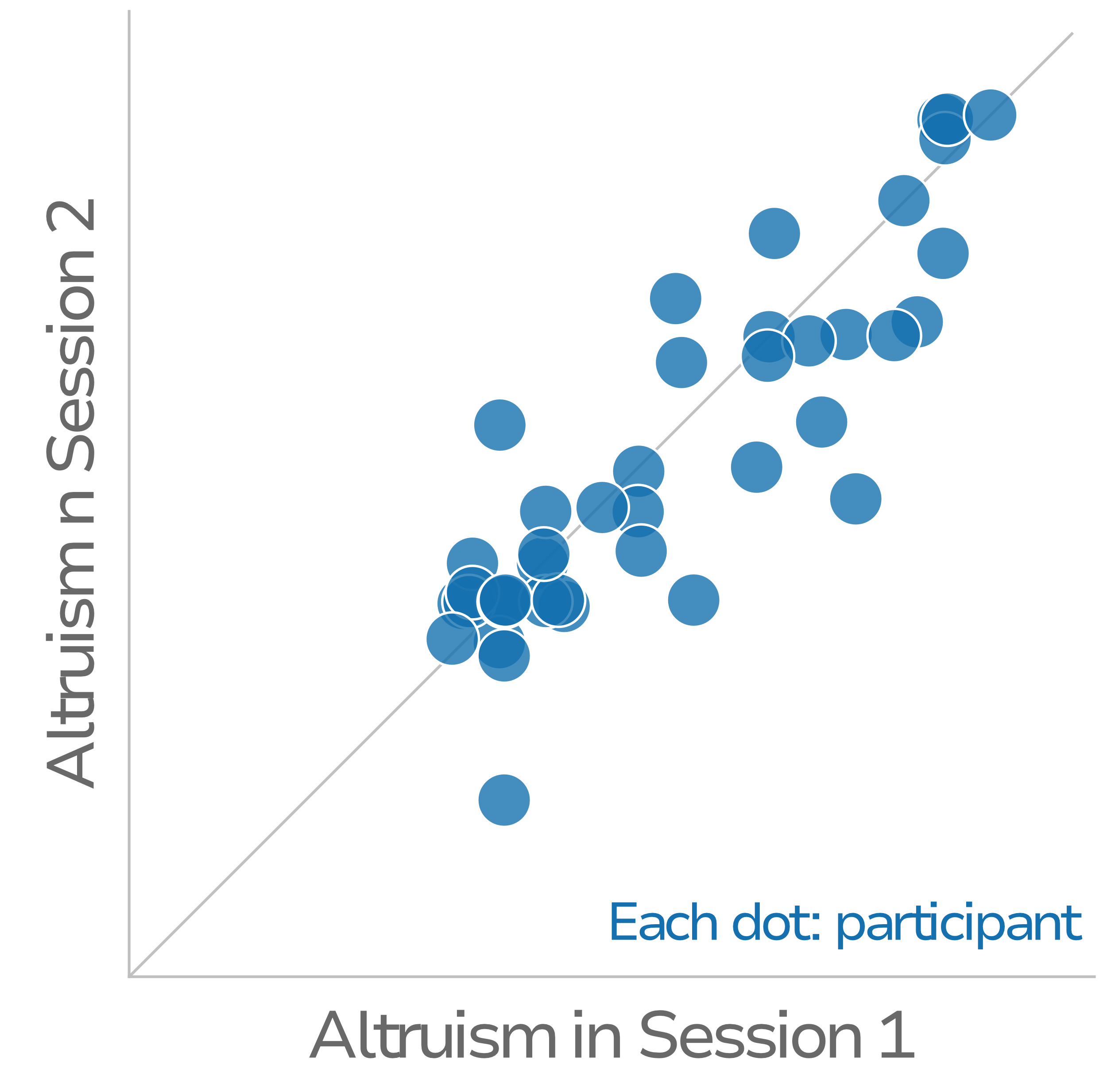
Each participant’s altruism, estimated from the hierarchical model, was highly consistent across sessions.
Furthermore, the equivalence testing showed no meaningful change in altruism across sessions.
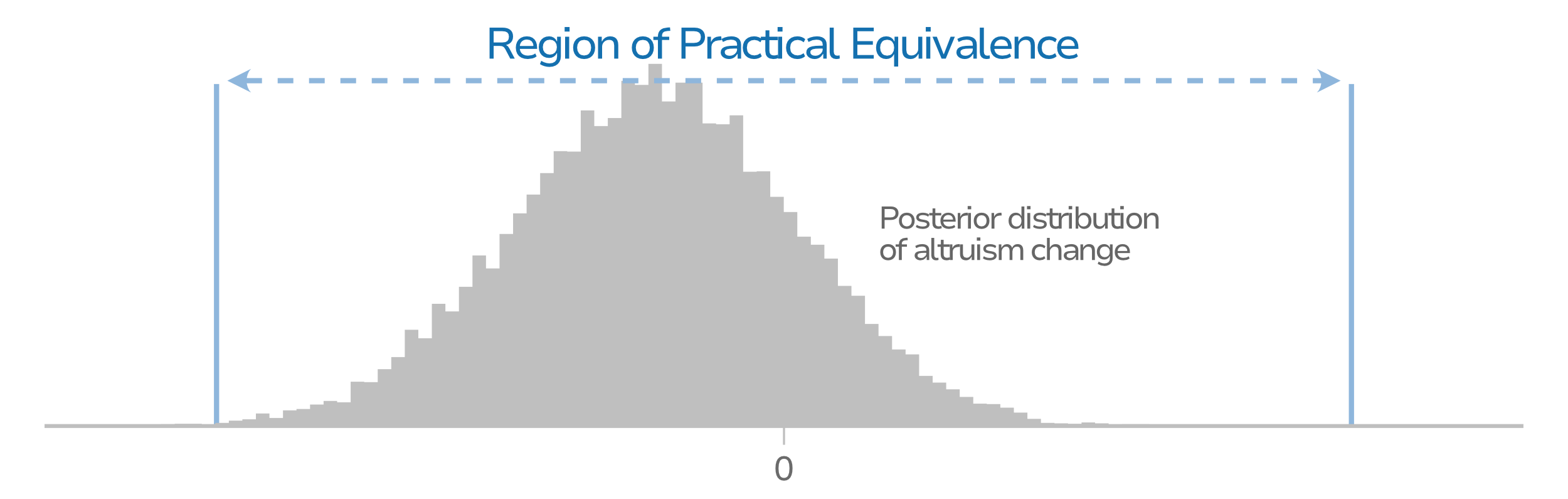
At the population level, altruism did not change across sessions. Change in altruism (Session 2 − Session 1) was estimated from the hierarchical model, and its posterior distribution fell within the smallest detectable change in our task (Region of Practical Equivalence).
These show that, when measured appropriately, individual altruism is a highly stable behavioral signature.
Note: In the full scientific study, the two sessions involved different brain stimulation conditions.