PROJECT:
Uncovering Why People Are Curious About Others
Social Curiosity ❖ Decision Modeling ❖ Bayesian Hierarchical Models ❖ Model Comparison
People are often curious about others, but what drives social curiosity?
I developed a decision-theoretic model of social curiosity and tested it in a controlled behavioral task. The results show that people are curious about social information selectively, only when it improves their subsequent decisions.
MY ROLE: I led the project end-to-end:
research questions and roadmap
a novel decision-theoretic model
design, optimization, and implementation of a behavioral task
data collection and automated preprocessing
modeling (Bayesian hierarchical model, model comparison, permutation)
visualization and interpretation
stakeholder communication
BEHAVIORAL INSIGHTS + industry implications
Research question
Is social curiosity general or selective? If curiosity is driven by what would change a person’s decisions, then individual behavioral patterns can reveal what information each person would actively seek out.
This has implications for personalization, content strategy, and information architecture across product, media, and financial services. If curiosity is individually predictable from behavior, organizations can then predict informational needs and develop more targeted, less overwhelming information delivery.
Study design
In a controlled task, I measured how much participants were curious about anonymous interaction partners.
Participants played an economic Trust Game with anonymous partners. Each partner could be one of two possible occupations (varied across choices; e.g., nurse vs. lawyer, politician vs. bartender). Before making a trust decision, participants could spend some money to reveal the partner’s actual occupation.
Finding
Participants were willing to pay for occupation information only when it would meaningfully change their subsequent trust decision. For example, participants tended to trust nurses more than lawyers or politicians. Therefore, knowing “nurse or lawyer” influenced trust, whereas “lawyer or politician” mattered much less. Participants indeed spent more on the former information than the latter.
Moreover, individual differences in trust strategies predicted curiosity. Those who changed their trust decisions more based on the occupation were the ones who paid more for that information.
Therefore, social curiosity is selective and individually predictable. For the design of personalized services, this means that we can use behavioral traces from individual users to predict their informational needs without explicitly eliciting their preference, reducing friction and improving engagement.
MODELING + data science relevance
Challenge
To formally test selective curiosity, I developed a new decision-theoretic model that predicted participants’ curiosity based on their own decision strategies. This model captured individual decision strategies using a few interpretable parameters, and I needed to ensure their estimation reliability. I also needed a formal approach to model comparison and hypothesis testing within this complex modeling framework.
Approach
To address these challenges, I used:
model simulation to optimize task design
Bayesian hierarchical modeling for reliable individual parameter estimates
within-individual cross-validation for formal model comparison
permutation testing (shuffling participant labels) to confirm that curiosity aligned with each individual’s own decision strategy
This combination enabled flexible, yet rigorous, statistical inference. This approach is generalizable to situations where multiple behavioral signatures need to be linked through interpretable models.
Results
My decision-theoretic model outperformed all alternatives, including non-hierarchical models.
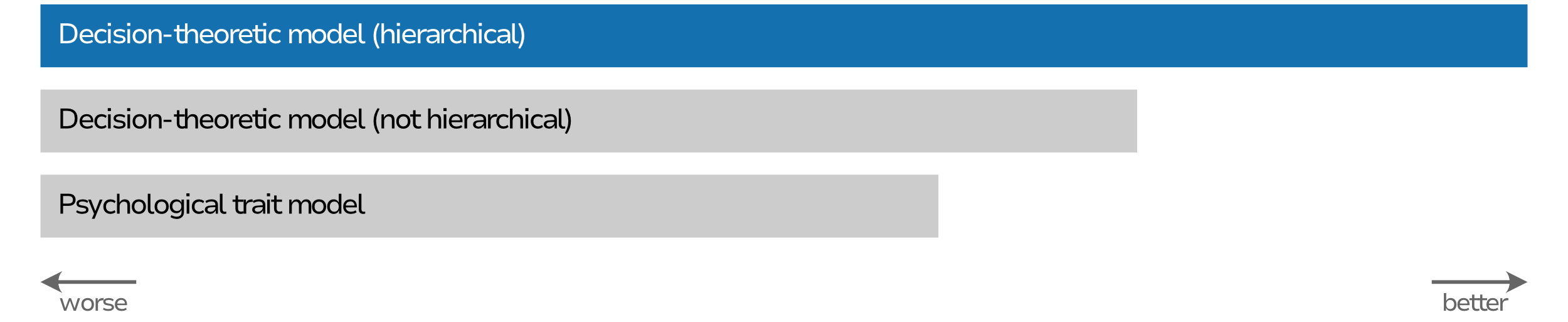
Each model’s performance was measured using cross-validated log likelihood relative to a null model (in which social curiosity was constant across all cases). The hierarchical version of the novel decision-theoretic model outperformed all others, including non-hierarchical variants and a model based on psychological traits.
Furthermore, permutation tests showed that each participant’s curiosity aligned with their own trust strategy, rather than another participant’s strategy.
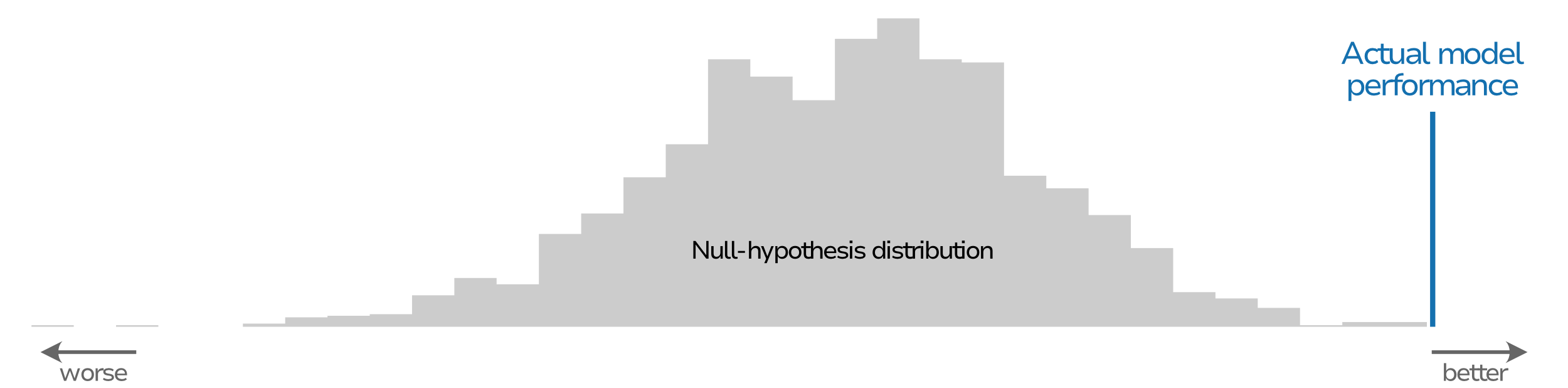
The null-hypothesis distribution of the model performance was generated by permuting each participant’s social curiosity and trust strategy. The actual model performance exceeded chance levels (p < .001), indicating a robust alignment between individuals’ trust strategy and social curiosity.
These indicate that social curiosity is selective for decision-relevant information and predictable from individual behavioral signatures.