PROJECT:
Discovering Structure of Social Impressions
Social Perception ❖ Survey Research ❖ Dimensionality Reduction ❖ Latent Structure Modeling
People form impressions of others’ traits (friendly, clever, dependable, etc). Do these impressions reflect many unrelated judgements, or a simple underlying structure?
Using large-scale surveys and dimensionality reduction, I uncovered a reproducible and interpretable low-dimensional structure.
MY ROLE: I led this project end-to-end, including:
research strategy, in collaboration with social and behavioral scientists
survey design
multi-platform online data collection
automated data preprocessing and quality control
dimensionality reduction (factor analysis)
visualization and interpretation
stakeholder communication
BEHAVIORAL INSIGHTS + industry implications
Research question
Is impression of others’ traits governed by a low-dimensional structure? A compact, reliable structure would allow organizations to efficiently measure, model, and act on social impressions at scale, which is beneficial for the design of experiences where people interact with other people or agents, such as recommender systems and chatbots.
Study design
I conducted online surveys on multiple platforms (Amazon Mechanical Turk, Prolific, university student pool; 500+ participants). Each dataset was analyzed separately and compared for reproducibility.
In the survey, participants rated 34 social traits (e.g., friendly, clever, dependable) for 24 occupations (e.g., nurse, lawyer, high school teacher). Occupations were tailored to the participant group to ensure familiarity. Each participant rated only a subset to reduce fatigue.
Finding
Trait ratings consistently reduced to three interpretable dimensions: Warmth/Trustworthiness, Competence, and Sociability. This structure was replicated across all datasets.
This finding demonstrates a reproducible, interpretable, and generalizable low-dimensional structure of social impressions. For products and services where people interact with other users or agents, this enables lightweight, scalable, yet valid measurement of social impressions that requires only a few traits (rather than dozens).
MODELING + data science relevance
Challenge
I needed a principled approach to discover a low-dimensional structure that is comparable across datasets. Additionally, I needed to deal with variable data quality on online surveys.
Approach
I developed an automated data pipeline to remove those who failed attention checks or showed highly irregular responses.
For dimensionality reduction, I used factor analysis to account for covariance across traits by a few key factors. Since each factor is a linear combination of traits, it is easily interpretable. In addition, factor analysis provides a principled way to computationally determine the number of factors (parallel analysis), ensuring robustness and reproducibility. Another important feature of factor analysis is that, unlike highly related Principal Component Analysis (PCA), it remains agnostic on orthogonality between factors.
Results
Across all datasets, factor analysis revealed the identical three-factor structure. Each factor was easily interpretable as Warmth/Trustworthiness, Competence, and Sociability.
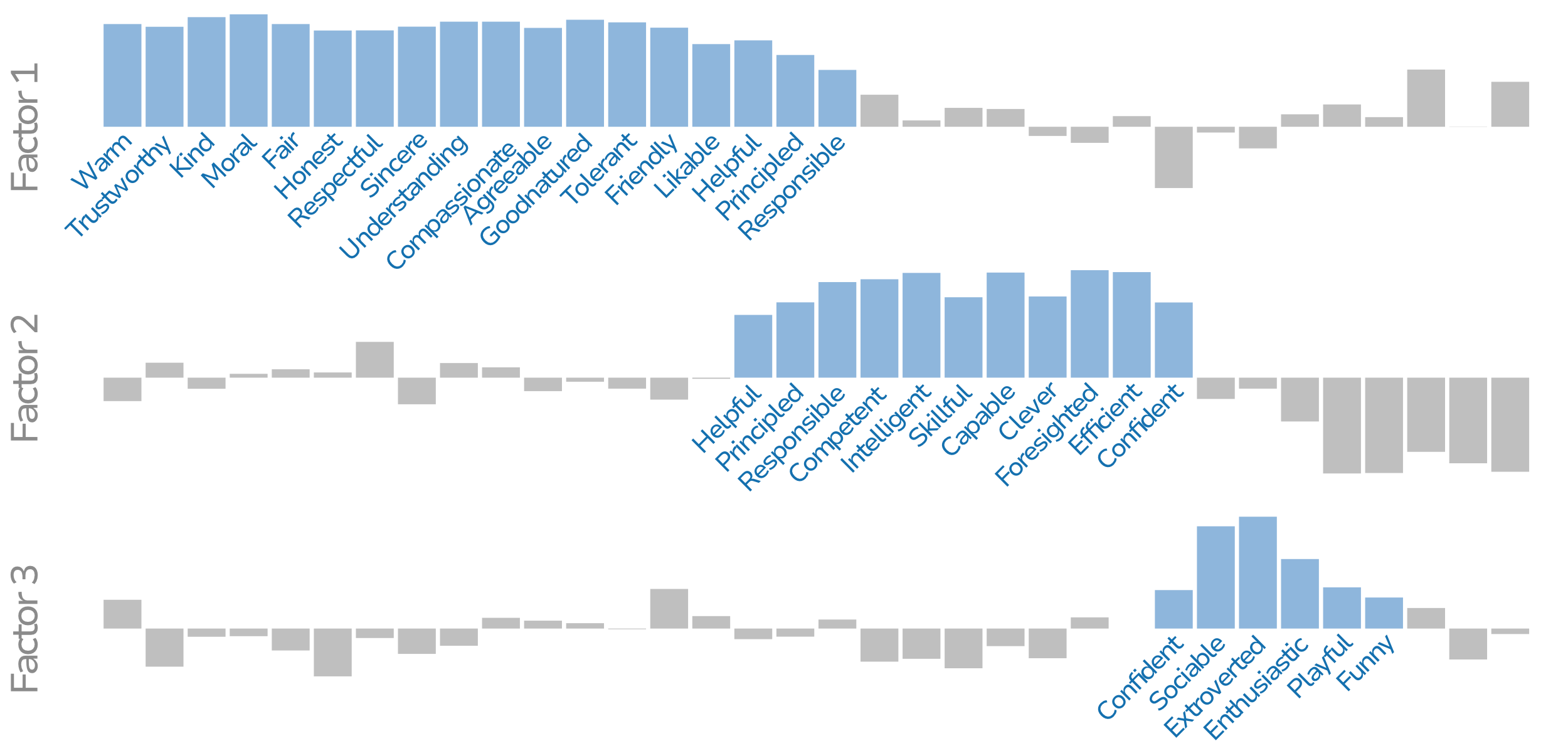
Factor analysis revealed three factors, each associated with traits related to warmth/trustworthiness, competence, and sociability, respectively.
This demonstrates that dimensionality reduction successfully uncovers interpretable latent structure in large and noisy behavioral observations.