PROJECT:
Predicting When People Think Information Is “Worth It”
Information Seeking ❖ Decision Modeling ❖ Gaussian Process Models ❖ Model Comparison
People sometimes gather additional information before deciding, but skip it in other situations. When do people think information is “worth it”, and why?
I designed a controlled behavioral task and built a new quantitative model to conduct causal inference on information seeking. I found that people selectively seek information to resolve conflict between possible actions.
MY ROLE: From a partially collected dataset, I delivered the full modeling pipeline:
analytical strategy
data cleaning and feature engineering
modeling (Gaussian Process regression, model comparison)
visualization and interpretation
stakeholder communication
BEHAVIORAL INSIGHTS + industry implications
Research question
When do people seek extra information before deciding, and why? This insight has wide implications for the timing and framing of information disclosure in product design, communication strategy, and decision support systems.
Study design
In a controlled task, participants chose between two options that yielded probabilistic rewards. Across choices, we manipulated:
which option was more desirable (higher reward)
which option participants believed was likely to yield rewards, and to what extent
Participants could either choose immediately or gather extra information first.
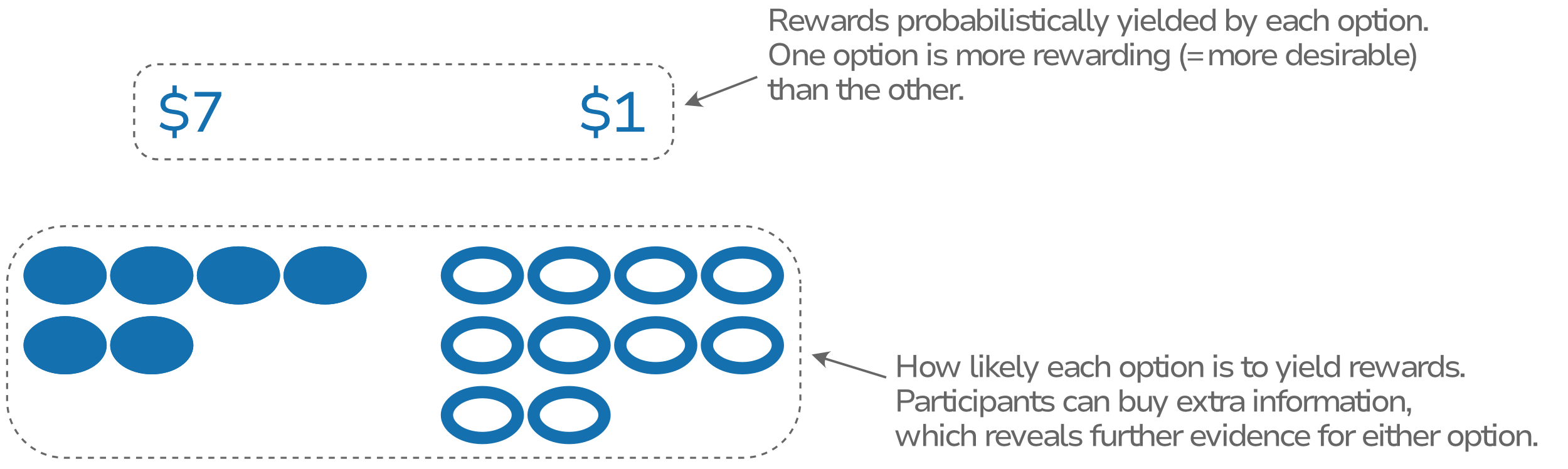
In the experimental task, participants chose between two options. Each option had a different likelihood of yielding rewards, visually indicated by the amount of evidence (ovals). Before deciding, they could gather extra information about how likely each option was to yield a reward.
Finding
Participants sought additional information not when they were most uncertain about which option was likely to reward them, but when the desirable option was currently less likely to reward them. In other words, participants’ information seeking was triggered by a conflict between the two options (the one desirable and the other supported by the current evidence).
Therefore, people strategically seek information to resolve conflict between possible actions. For product and content designs, this means that prompting users to engage with additional information is most effective at the point of decision conflict, rather than general uncertainty.
MODELING + data science relevance
Challenge
Prior to this project, there was no established modeling approach to information seeking. I developed a new approach to uncover the relationship between information seeking and the key experimental variables (which option was desirable, which option was expected to be rewarding). It was critical to estimate the relationship without imposing a specific structure (e.g., linear, quadratic), so that I could conduct a valid statistical inference on its shape.
Approach
I used Gaussian Process (GP) logistic regression. GP regression is a principled way to estimate smooth functions without imposing a form. It is a powerful tool in any domain where we need to uncover interpretable behavior patterns shaped by multiple factors in some unknown manner.
Results
GP regression revealed that participants gathered information the most when the current evidence favored the undesirable option, supporting our behavioral insight that information seeking is triggered by conflict between possible actions.
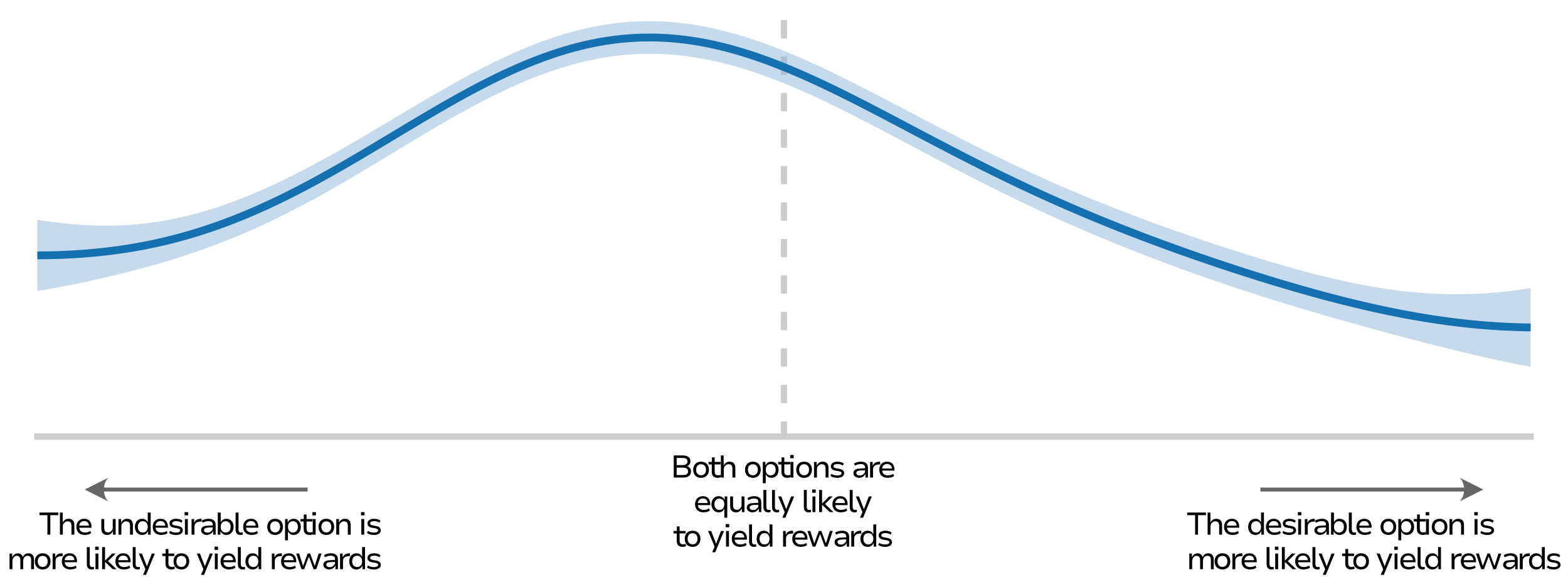
Participants’ tendency to gather extra information peaked not when both options were equally likely to yield rewards, but when the undesirable option was slightly more likely to yield rewards.
To further evaluate the statistical evidence for this claim, I conducted model comparison by cross validation (leave-one-participant-out). My original model (driven by a conflict between actions) outperformed alternatives.
This demonstrates that GP regression, combined with proper techniques such as cross validation, supports rigorous statistical inference while remaining flexible and interpretable.
Note: Modeling code and behavioral data are available at https://gitlab.com/kenji.k/beadsVOI/.